






EDUCATION AND RESEARCH CENTER OF LEGAL MEDICINE,
CHIBA UNIVERSITY
ANNUAL REPORT 2025
Preface
At the Education and Research Center of Legal Medicine (Chiba University), we perform autopsies and various tests on deceased individuals, mainly from Chiba Prefecture, when law enforcement agencies identify the need for forensic investigation. Our objective is to determine the cause of death from a medical perspective. We perform DNA analyses and dental examinations for the purpose of body identification, furthermore, we receive requests for forensic diagnoses from child consultation centers, prosecution teams, and prefectural police regarding living individuals.
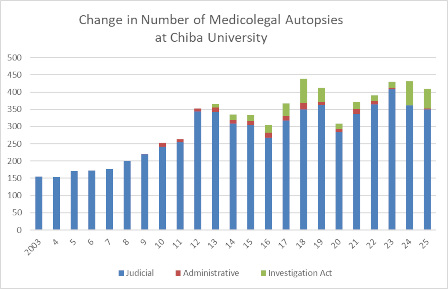
In 2025 the total number of autopsies conducted was 409, marking a decrease of 22 compared to the autopsies performed at Chiba University in 2024. Compared to the previous year, both the number of judicial autopsies and autopsies performed in compliance with the Investigation Act (investigative autopsies) decreased. In the past few years, the number of autopsies has been staying about the same.
Based on the Act for the Promotion of Death Investigation (in effect until 2014) and the Basic Act for the Promotion of Death Investigation (enforced in 2020), several plans for promoting investigations into causes of death were approved by the Cabinet, and discussions on death investigations have continued within the government. However, there are no measures leading to fundamental reform, and hardly any new budget has been allocated either. Regarding Child Death Review (CDR) for prevention, cases subject to judicial autopsy tend to be excluded, and since it requires the consent of the bereaved family, there is a possibility that proper consideration of abuse, accidents, or suicides may be inadequate. Nevertheless, the situation regarding death investigations has been at a standstill. As for clinical forensic medicine, which deals with the examination of living bodies rather than deaths, some institutions, such as Chiba University, have been making progress, but nationwide there are still very few institutions carrying it out.
Notably, we not only collect relevant information on dead people, determine the exact cause of death, and identify bodies, but also determine the death trends in Japan and help prevent accidents and disasters as well as the recurrence of murders and suicides. Our social mission is to maintain and improve the safety and health of the population. Given this context, we aim to increase awareness of the present challenges by providing information on the causes of death, and hope to contribute to system improvements by initiating constructive discussions leading to modifications in how causes of death are investigated in our country.
Classifying the manner and causes of death
In this report, the manner of death is classified as natural, accidental, suicide, homicide, undetermined external cause, and undetermined. For the cause of death deemed as “natural,” we employ the medium rank classification from the simple classification of causes, drawing on vital statistics data obtained from the Ministry of Health, Labour, and Welfare. Accidental deaths are further subdivided based on the results indicated on the corpse examination certificate, such as traffic accidents, falls, drowning, asphyxiation, fire, and other causes. For suicide cases, we use the classification of the Tokyo Metropolitan Medical Examiner’s Office and classify cases as hanging, sharp force, gunshot wound (GSW), drugs and poisoning, drowning, use of a moving vehicle, thermal injury, jumping from a high place, and other causes. For homicide cases, we refer to the classification used by medical examiners in the United States and classify cases as child abuse, strangulation, sharp force, GSW, fire and thermal injury, blunt force, and other causes. While many countries use five classifications to specify the manner of death, in Japan, owing to a significant proportion of unidentified bodies with undetermined manners of death, we introduce the “undetermined external death” category. This is reserved for cases in which the manner of death is unknown, but its direct cause can be determined, such as drowning.
Overview
In 2025, the population of Chiba Prefecture was approximately 6,277,000. A total of 75,862 deaths were reported in this prefecture; 11,581 deaths were reported to the police department, 11,377 to detectives, and 204 to the Traffic Bureau. In total, 540 judicial autopsies were performed, 516 to detectives, and 24 to the Traffic Bureau. Administrative autopsies were five, and 121 autopsies were performed in accordance with the Investigation Act. Overall, the police conducted 666 medico legal autopsies, and adding the ten conducted by the Japan Coast Guard and the five conducted by the Chiba District Public Prosecutors Office, the total number of medico legal autopsies was 681. Of these, 629 were judicial autopsies, 5 were administrative, 84 were investigative autopsies (a 45.2% increase from the previous year). The rate of medico legal autopsies to the total number of deaths was approximately 0.9% (the national average is approximately 1.3%). Considering Chiba Prefecture as a whole, a notable feature of this year was a decrease in the number of judicial autopsies and a significant increase in the number of investigative autopsies.
On the other hand, 409 medico legal autopsies were performed at our center in 2025, representing a 5.1% decrease over the previous year. These autopsies included 350 judicial autopsies, three administrative, and 70 investigative autopsies. Among the judicial autopsies, 343 were commissioned by the Chiba Prefectural Police (327 by detectives and 16 by the Traffic Bureau), 5 by the Chiba District Prosecution, and 2 by the Ibaraki Prefectural Police Department. Among administrative autopsies, 1 was by detectives and 2 was by Traffic Bureau, and all the investigative autopsies were conducted by detectives.
In the fiscal year 2018, forensic pathologists in the center, instead of physicians, began to perform some services under the jurisdiction of the Chiba Central Police Office. They performed 6 postmortem examinations in 2025. Apart from autopsies, forensic radiologists performed 37 postmortem examinations using computed tomography (CT).
Laboratory examinations, drug and poison tests, pathology organization inspection, blood typing, blood biochemical tests, and other tests were performed on all corpses as required, and specimens were obtained. Where required, the bodies were examined for signs of carbon monoxide poisoning and for the presence of plankton and sperm. First, we performed CT imaging studies; subsequently, we performed autopsies, obtained various test results, investigated the condition of the deceased, and comprehensively estimated the cause and manner of death.
With respect to forensic odontology and genetics, we confirmed the identity of unidentified human remains using dental records and DNA testing. However, as a rule, DNA-type testing of corpses handled by the police had to be conducted at a crime laboratory. Therefore, the Chiba Prefectural Police did not request this service. We incorporated testing of cases other than those in Chiba according to cooperative agreements with other universities.
Regarding clinical forensic medicine, we received 107 requests from child consultation centers in Chiba Prefecture, Chiba City, Chiba Prefectural Police, and Chiba District Prosecution. Accordingly, we established the forensic diagnosis.
Nationalities
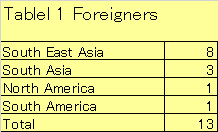
Table 1 shows the nationalities of the bodies managed by our center in 2025. Thirteen participants were foreign nationals from four different regions. Many of them were from Southeast and South Asia.
Judicial autopsies
Judicial autopsies were performed on 350 corpses in 2025. The details are outlined below:
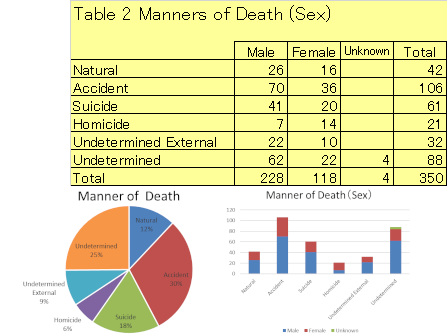
Table 2 shows the manner of death for all corpses managed by our center. We recorded 42 (12%) natural deaths, 106 (30%) accidents, 61 (18%) suicides, 21 (6%) homicides, 32 (9%) deaths associated with undetermined external causes, and 88 (25%) deaths owing to unknown causes. The number of natural deaths has decreased, while accidental deaths have increased compared to previous years. The death rate was approximately 1.9 times higher in men than in women, and men outnumbered women in the manners of death except homicides.
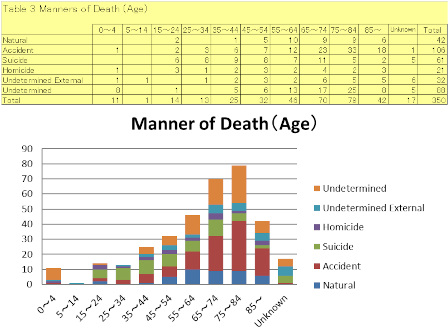
Table 3 shows the age distribution of the corpses managed at our center. The mean and median ages were 63 and 61 years, respectively. The mean and median ages based on the cause of death were 67. 69 years for natural death, 70,74 for accidental death, 51,52 for suicide, and 55,56 for homicide, respectively.
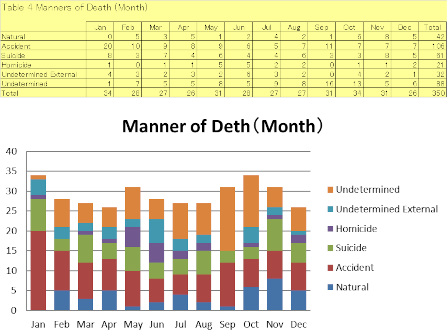
Table 4 shows the monthly distribution of deaths based on manners of deaths. Although the number was slightly higher in January and October, no significant difference was observed.
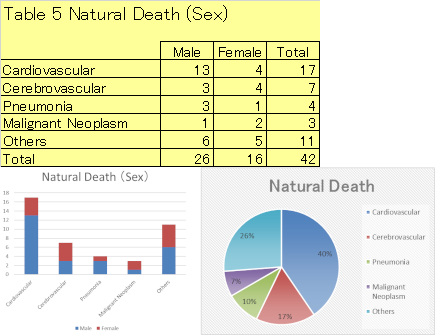
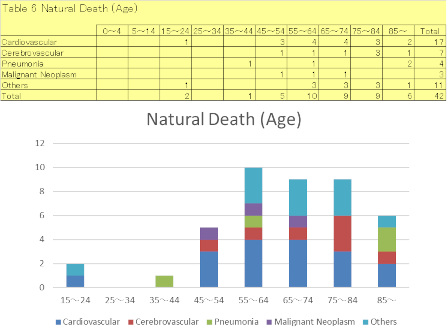
Tables 5 and 6 show the causes of natural deaths. Although the number of deaths was too low to draw definitive conclusions, the causes of natural deaths were like those that contributed to the overall mortality statistics of the population (heart disease, cerebrovascular disease, and malignancy). People aged 65 years and over slightly decreased compared to previous years.
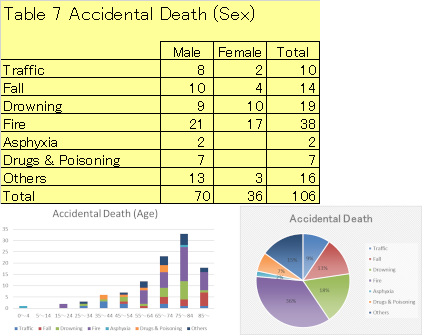
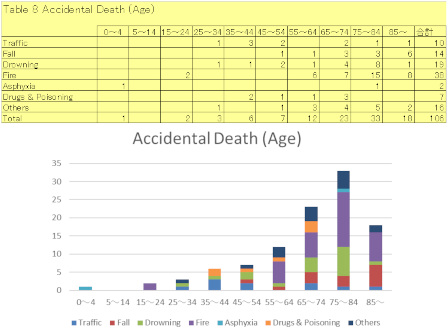
Tables 7 and 8 list the causes of accidental deaths. In 2025, fires remained the leading cause of accidental death, followed by drownings, other accidental deaths, and falls. More than half of other accidental deaths were attributed to heat stroke and hypothermia. And there were a lot of young and middle-aged corpses who died from work-related incidents. By age group, for fire, falls, and drownings, people in their 70s and older are the most common, and they died because they could not evacuate from fires quickly and often fell into irrigation canals.
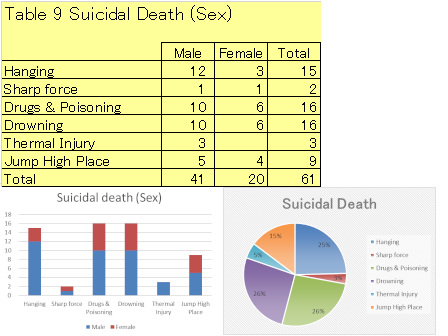
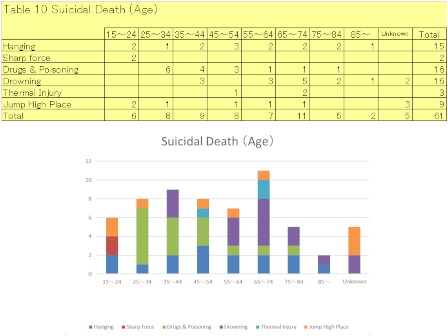
Tables 9 and 10 list suicide methods. Although hanging used to be the most common in previous years, poisoning and harmful substances, and drowning slightly surpassed hanging and ended up being the same in 2025. Most of the poisoning and harmful substance cases were carbon monoxide poisoning from using charcoal, and this was more common among younger people. Drowning tended to be more common among middle-aged and older people. Men are still the majority. By age, suicides are spread widely from teenagers to people in their 80s.
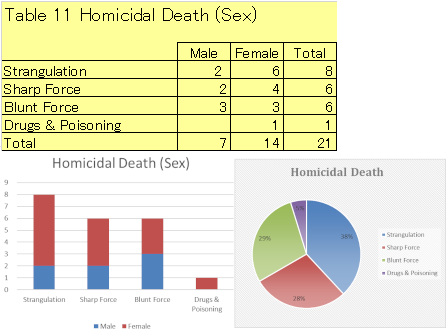
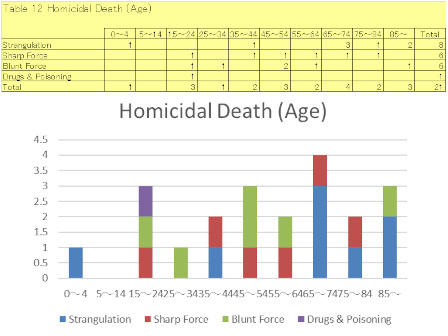
Tables 11 and 12 list the homicidal deaths recorded in 2025. The number of homicide cases was about the same as usual. The methods of murder?strangulation, sharp force, blunt force ?were roughly equal in number. In 2024, unusually, there were more male victims than female, but in 2025, as usual, most of the victims were women. The victims’ ages varied widely.
Among the 32 deaths due to undetermined external causes, 16 were attributed to drowning. Although the direct cause of death can be determined, the manner of death (accident, suicide, or homicide) remains unknown. Particularly in drowning cases, it is often possible that death was the result of suicide.
This year, the number of undetermined deaths decreased. However, as usual, most of bodies were difficult to identify because they were skeletal, adipocere, mummified, or severely decomposed. In the remaining cases, there are corpses of unknown internal or external causes, and some cases which are thought to be stillborn. There were also a few cases of sudden infant bodies which might have died from suffocation.
Administrative autopsies (autopsies that required deceased family’s consent)
According to Article 7 of the Postmortem Autopsy and Preservation Act, consent autopsies are referred to as administrative autopsies under Chiba Prefecture's ordinance. Since the implementation of the Investigation Act, most consent autopsies nationwide have been replaced by investigative autopsies, and in Chiba Prefecture, there were zero cases in the previous year and only five in 2025, and three of them were autopsied in our center. Of the three cases, one was a traffic accidental death, and two were natural deaths (malignant neoplasm and pneumonia). Two were aged 65-74 and one was 75-84, and all of them were men.
Autopsies performed in compliance with the Investigation Act (investigative autopsies)
In 2024 the number of investigative autopsies increased significantly, because the National Police Agency changed its policy to conduct investigative autopsies even for unidentified cases if there was little sign of a crime. However, in 2025 the number of them decreased slightly from 70 cases to 56 cases.
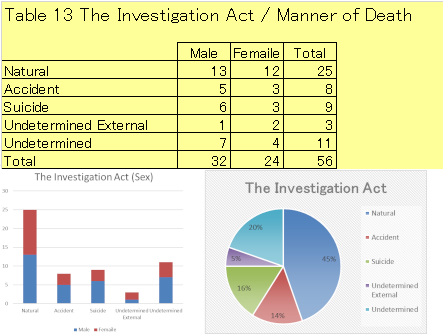
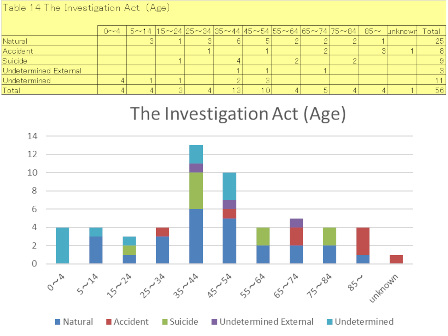
Tables 13 and 14 show the manner of death and age distribution of the bodies. Judicial autopsies accounted for 12% of deaths from natural causes, whereas investigative autopsies accounted for 45%. The types of illnesses were like those in judicial autopsies, and most deaths were male. The mean age of those who underwent judicial autopsies was 63 years, while that of those who underwent investigative autopsies was 44 years old. There have been many cases involving relatively young people, 30’s and 40’s years.
Child deaths
In 2025, autopsies were performed on 23 children under 18 including infants. Among these, 15 autopsies were conducted judicially and eight were under the Investigation Act. Manners of death were as follows: three natural causes, two suicide, one homicide, two undetermined external, and 13 unknown causes. Both the suicides were at age 17, and the homicide case involved a mother who killed her child and then attempted suicide. Both cases with unknown external causes were cases where it was impossible to determine whether abuse or an accident caused the death. Out of the cases of unknown death, eight were sudden infant deaths, suspected nasal and oral obstruction or sudden infant death syndrome (SIDS), and four involved infants or stillbirths that were possibly abandoned at or shortly after birth.
CT examinations
CT examinations without autopsies were performed on 46 corpses in 2023. However, in all corpses, CT examinations were performed prior to autopsies, including judicial, administrative, and autopsies under the Investigation Act. In addition, approximately 80 readings were performed, including individual identification by imaging, readings of biomedical images related to clinical forensics, and readings of CT images acquired at other institutions. Magnetic resonance imaging (MRI) has also been adopted, although it is still in the research stage.
Forensic odontology
Dental findings were collected and recorded in appraisal reports for almost all forensic autopsies of unidentified bodies. In addition, based on a partnership agreement, we collected dental findings from unidentified corpses that had undergone forensic autopsies at the University of Tokyo (UT) and the International University of Health and Welfare, together with the Department of Forensic Dentistry, the Institute of Science, Tokyo. A case study meeting was held under a comprehensive partnership agreement with the Chiba Dental Association. In the child guidance center cases requested by our center, we performed intraoral evaluations in cases that required intraoral findings, such as multiple dental caries and bite marks.
Forensic genetics
DNA testing is performed for personal identification and paternity testing at the request of courts and non-official organizations. Moreover, because of the cooperation agreement between Chiba University and the UT, we performed DNA typing tests as requested by the UT, Tokyo District Public Prosecutors Office, and the Metropolitan Police Department.
Forensic toxicology
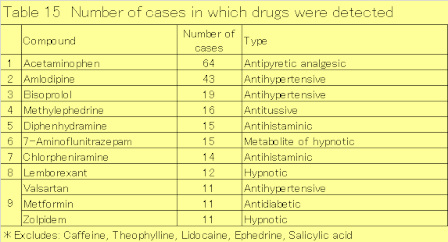
Rapid screening tests are performed on all deceased cases from which specimens can be collected, alongside toxicological screening and analysis (qualitative analysis, and quantitative analysis as necessary) using mass spectrometry (LC-MS/MS, LC-QTOF/MS, and GC-MS). The major drugs detected at Chiba University this year are shown below (Table 15). Bisoprolol was detected in 19 cases (a 2.7-fold increase compared to the previous year), and Lemborexant in 12 cases (a 3-fold increase). The stimulant methamphetamine was detected in 7 cases (ranked 16th).
Clinical forensic medicine
At the request of the child consultation centers in Chiba Prefecture, Chiba City, and Edogawa Ward, we submitted 93 written opinions related to child abuse and domestic violence. In addition, we received and responded to 14 consultations on injury cases from the Chiba District Prosecution and Chiba Prefectural Police, among others. In July 2018, a clinical forensic outpatient department was opened within the Pediatric Division of Chiba University Hospital. The hospital’s pediatric and forensic departments cooperated to enhance the examination system. With the cooperation of other specialized departments, we aim to ascertain injuries caused by abuse, among other causes.
Chiba CDR
Every year, we hold the Chiba Child Death Review (CCDR), where experts in Chiba Prefecture?including pediatricians, government officials, and members of the judiciary?share information on child death cases and discuss ways to prevent their recurrence. On March 28, 2025, the 18th meeting was hosted by the School of Medicine at Chiba University. At this meeting, we reviewed two cases where infants died while sleeping and talked about how to prevent accidents in babies and toddlers. Many people participated in this study group, including doctors and researchers in forensic medicine and pediatrics, as well as representatives from the Chiba District Public Prosecutors Office, Chiba Prefectural Police, and government agencies.
Disaster victim identification training
The 7th Chiba Large-Scale Disaster Victim Identification (DVI) drill was held at the International University of Health and Welfare in 2025. Assuming an explosion accident at a petroleum refining plant, we reviewed the procedures for death investigations in disasters and identification work, including the adequacy of each agency's manuals. This was conducted in collaboration with the Department of Forensic Medicine at the International University of Health and Welfare, co-hosted by the Chiba Medical Association and Chiba Dental Association, and involved the Chiba Prefectural Police, neighboring municipalities, and the Chiba Coast Guard.

